|
|
| Welcome to St.Petersburg - sights |
|
The Church of the Saviour on Spilled Blood
|
|
|
Legal address: 2a Kanal Griboyedova,
190000 St. Petersburg, Russia
Tel: +7- (812) 315-16-36
Open: 11.00 - 19.00
Closed: WEDNESDAY |
|
|
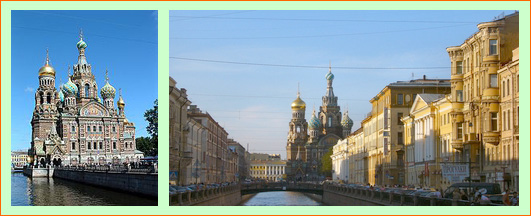
The Church of the Savior on Spilled Blood (Храм Спаса на Крови) is one of the main sights of St. Petersburg, Russia. It is also variously called the Church on Spilt Blood and the Cathedral of the Resurrection of Christ (Собор Воскресения Христова), its official name. This marvelous Russian-style church was built on the spot where Emperor Alexander II was assassinated in March 1881. Built in 1883-1907 by the architect Parland, this church was designed in the spirit of 16th-17th century Russian architecture and resembles St.Basil's Cathedral in the Red Square in Moscow.
|
|
| |
|
|
| |
|
The Church is prominently situated along the Griboedov Canal. The embankment at that point runs along either side of a canal. As the tsar's carriage passed along the embankment, a grenade thrown by an anarchist conspirator exploded. The tsar, shaken but unhurt, got out of the carriage and started to remonstrate with the presumed culprit. Another conspirator took the chance to explode another bomb, killing himself and mortally wounding the tsar. The tsar, bleeding heavily, was taken back to the Winter Palace where he died a few hours later.
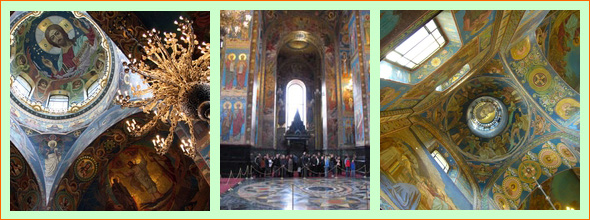
Most of the money for the church was donated by the royal family and thousands of private investors. Both inside and outside the church is decorated with unique mosaics whose surface was left unpolished so that they could better reflect sunlight.
After the October Revolution of 1917 the church met the sad fate of most churches in the country. "The Savior" was closed for services in the late 1920s, then briefly used for an exhibition of revolutionary propaganda and soon started to fall into decay, being deprived of adequate maintenance. Several times it was suggested that the church be torn down, for it stood as an "inappropriate" symbol of Christianity amidst the largely atheistic country. It is by a true miracle that the church was saved. Since 1970 the church has been managed by the staff of the St.Isaac's Cathedral. A long careful restoration began, which lasted for over 25 years.
|
|
| |
|
|
| |
|
Now with scaffolding already removed, the bell-tower dome gilded, and the interiors carefully restored, the church opened its doors to visitors. The official opening took place in August, 1997 and you can now see this jewel in the crown of St. Petersburg in its stunning beauty.
|
|
|
|
| |
|
Contact us if you like to travel to St.Petersburg, Russia
|
| |
|
|